Producer: Send Messages
This page describes how Korvet handles Kafka ProduceRequest operations.
| This page is implementation-oriented and focuses on Kafka-to-Redis mapping details. |
Producer Sends Messages
Kafka Wire Protocol
ProduceRequest {
  transactional_id: null
  acks: 1                    // 0=no ack, 1=leader ack, -1=all replicas
  timeout_ms: 30000
  topics: [
    {
      name: "orders"
      partitions: [
        {
          index: 0
          records: [
            {
              offset: null   // assigned by broker
              timestamp: 1234567890000
              key: "order-123"
              value: {"product": "widget", "quantity": 5}
              headers: [
                {key: "source", value: "web"},
                {key: "version", value: "1.0"}
              ]
            },
            {
              offset: null
              timestamp: 1234567891000
              key: "order-124"
              value: {"product": "gadget", "quantity": 3}
              headers: []
            }
          ]
        }
      ]
    }
  ]
}
ProduceResponse {
topics: [
{
name: "orders"
partitions: [
{
index: 0
error_code: 0 // NONE
base_offset: 42 // first offset assigned
log_append_time: 1234567890123 // broker append time (ms); -1 unless topic uses LogAppendTime
log_start_offset: 0
}
]
}
]
throttle_time_ms: 0
}
Redis Commands Detail
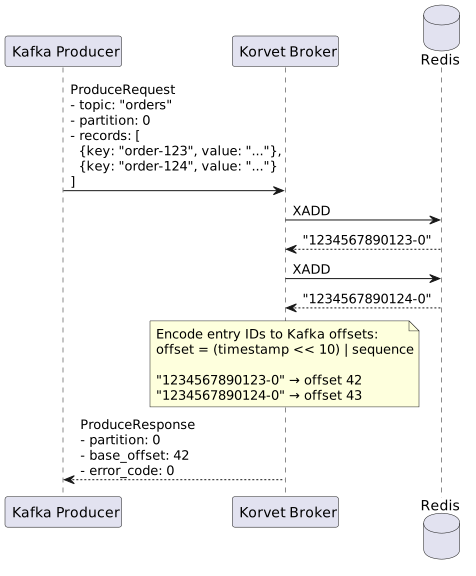
Produce handling translates records into one or more XADD operations on the target stream key.
The returned Redis entry IDs are converted to Kafka offsets using the topic’s configured offset mapper.
Implementation Notes
-
Pipelining: Batch multiple XADD commands for better throughput
-
Chunked Writes: Large batches may be split into smaller chunks before writing.
-
Idempotent Retry Handling: Duplicate producer batches can be detected and skipped before storage writes.
-
Offset Encoding: Kafka offsets are derived from Redis entry IDs using the topic-specific
sequenceBitsconfiguration. -
Retention: Retention trimming is not applied at produce time. A leader-locked background storage worker enforces retention by issuing
XTRIMagainst partition streams.
ProduceRequest {
  topics: [
    {
      name: "orders"
      partitions: [
        {
          index: 0
          records: [
            { key: "order-123", value: "...", timestamp: 1234567890, headers: {...} }
            { key: "order-124", value: "...", timestamp: 1234567891, headers: {...} }
          ]
        }
      ]
    }
  ]
}# The entry ID is broker-assigned (not *), and the record is broken out into
# value/key/headers/timestamp fields (fields absent for null components).
XADD korvet:storage:local:orders:0 <assigned-id> value <value-bytes> key <key-bytes> timestamp <ms>
XADD korvet:storage:local:orders:0 <assigned-id> value <value-bytes> timestamp <ms>-
Redis returns entry IDs:
["1234567890123-0", "1234567890123-1"] -
Encode entry IDs as Kafka offsets:
offset = (timestamp << sequenceBits) | sequence -
Return base_offset in ProduceResponse
# No mapping storage needed - conversion is stateless
# Entry ID to Kafka offset:
#   offset = (timestamp << sequenceBits) | sequence
# Kafka offset to Entry ID:
#   timestamp = offset >> sequenceBits
#   sequence = offset & ((1 << sequenceBits) - 1)
#   entry_id = "{timestamp}-{sequence}"
