Tiered Storage
Korvet stores all messages in Redis Streams (the local tier) and can optionally archive older data to Apache Iceberg tables on an object store (the remote tier) for cost-efficient long-term retention. This section covers both tiers and how data moves between them. For the foundational storage model, see Concepts & Architecture; for the exact Redis key layout, see Redis Data Structures.
Storage Architecture
Korvet supports two storage configurations:
Redis-Only Storage (Default)
The default configuration uses Redis Streams exclusively:
-
Primary storage: All messages stored in Redis Streams
-
Persistence: Redis AOF and RDB for durability
-
Consumer groups: Built-in support for coordinated consumption
-
Performance: Sub-millisecond read/write latency
-
Retention: Configurable time and size-based retention (applied by the background storage worker via
XTRIM)
This is the recommended configuration for most use cases.
Tiered Storage (Local → Remote)
For long-term data retention and cost optimization, Korvet can be configured with tiered storage. Because a tiered partition is split into fixed-size segments (see How It Works), the data naturally spans three temperature tiers:
-
Hot tier (RAM): The current open segment lives in Redis memory and receives all writes, giving sub-millisecond produce and fetch latency.
-
Warm tier (flash/disk): Sealed segments that are still within the local retention window. With Redis Flex (Auto Tiering, formerly Redis on Flash), Redis transparently keeps these colder sealed segments on SSD/flash while keeping the hot working set in RAM — no Korvet configuration required. Without Redis Flex, sealed segments simply remain in RAM until they are offloaded or expire.
-
Cold tier (object store): Offloaded sealed segments archived to Apache Iceberg tables (one per topic) on S3 (or any Iceberg-supported object store / Hadoop-compatible filesystem).
Key points:
-
Automatic archival: The built-in storage worker continuously offloads sealed segments from the local tier (hot/warm) to the cold tier.
-
Transparent to Redis Flex: Segmentation is what makes the hot/warm split work — each sealed segment is a separate Redis Stream key, so Redis Flex can demote whole segments to flash based on access patterns.
-
High throughput: Achieves 100k+ messages/second to S3 with parallel streams.
How It Works
Redis-Only Storage
-
Produce: Messages are written to Redis Streams using
XADD -
Retention: A background storage worker applies retention policies using
XTRIM(MAXLENfor count/byte limits,MINIDfor time limits) -
Consume: Consumers read messages using
XREAD(standalone) orXREADGROUP(consumer groups) -
Persistence: Redis handles durability through AOF/RDB snapshots
Fetch wake-up notifications
An empty Kafka fetch is parked without periodically issuing XREAD or XREADGROUP. After Korvet
successfully appends a record, it signals fetches parked for that logical topic-partition on the
same broker. Kafka routes produce and fetch requests for a partition to its current leader, so the
append and its parked fetches share an in-process notifier. Notifications are only wake-up hints;
records and consumer-group state remain authoritative in Redis Streams.
An XADD issued directly by an external Redis client bypasses Korvet’s append notification. The
record remains readable and is discovered by the next fetch, but it does not promptly wake a fetch
that is already parked; that fetch first completes at its existing fetch.max.wait.ms deadline.
Tiered Storage
A topic partition is treated as a sequence of fixed-size segments. Segmentation is not specific to
tiered storage: every newly created topic is segmented by default (see segment.bytes / segment.ms in
Topics), regardless of whether remote.storage.enable is set or log
compaction is enabled. In a Redis-only deployment the segments simply stay in Redis; tiered storage adds
offloading on top. Compaction scans sealed local segments and removes superseded keyed records across
segment boundaries. The open segment remains uncompacted until it rolls, matching Kafka’s active-segment
behavior. Remote storage and compaction cannot currently be enabled together.
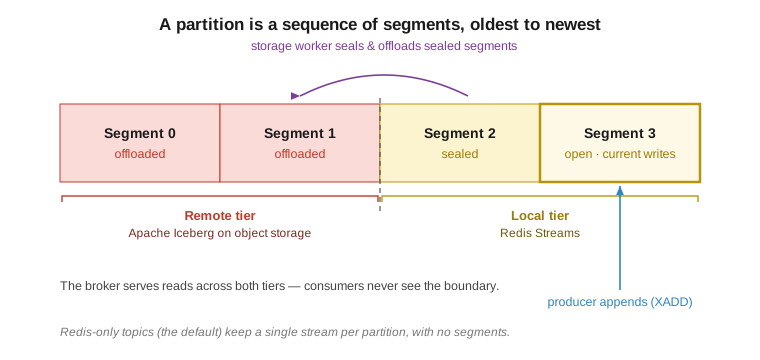
With tiered storage, the newest segment (the open segment) lives in Redis and receives all writes; older sealed segments are offloaded to the remote tier and dropped from Redis once local retention expires. Reads are served transparently across all tiers, so a consumer never sees the tier boundary.
-
Produce (hot): Messages are appended (
XADD) to the open segment in Redis RAM (hot tier). -
Seal (warm): When the open segment reaches its configured size or age (
segment.bytes/segment.ms), the storage worker seals it and opens the next one.segment.bytesis compared against the segment’s real stored size (RedisMEMORY USAGE), not an estimate. Sealed segments remain in the local tier; with Redis Flex enabled, Redis can demote these colder segments from RAM to flash automatically (warm tier). -
Archive (cold): The leader-locked storage worker streams sealed segments from Redis into the topic’s Apache Iceberg table on the remote object store (cold tier), then marks them offloaded.
-
Consume: Consumers read transparently across tiers — the broker reads from local Redis (RAM or flash) or the remote table depending on which segment holds the requested offset.
-
Cleanup: After
local.retention.ms, offloaded segments are dropped from Redis; the totalretention.msgoverns when they are removed from the remote tier.
|
The hot/warm split is handled entirely by Redis Flex and requires no Korvet configuration — Korvet only distinguishes local (Redis) and remote (object store) tiers. Segmentation is what lets Redis Flex operate per-segment: each sealed segment is its own stream key, so the colder ones can live on flash while the open segment stays in RAM. |
Per-Topic Tiered Storage Configuration
Tiered storage is controlled at the topic level using Kafka-compatible configuration:
-
remote.storage.enable=true- Enable tiered storage for a topic (Kafka KIP-405) -
local.retention.ms- Time to keep in local tier before moving to remote -
retention.ms- Total retention across all tiers
Example: 1 hour local, 6 days remote (7 days total):
kafka-configs --bootstrap-server localhost:9092 \
  --entity-type topics --entity-name my-topic --alter \
  --add-config remote.storage.enable=true,local.retention.ms=3600000,retention.ms=604800000
See Topic Configuration for full details.
Legacy single-stream topics can be migrated to the segmented layout in place — see Migrating a Single-Stream Topic to Segmented Storage.
Storage Layout
Each topic partition maps to a Redis Stream, and each Kafka record is stored as a single stream entry
whose body breaks the record out into separate, directly-readable value, key, headers, and
timestamp fields. When tiered storage is enabled, a partition is split into per-segment streams that
are offloaded to the remote tier as they seal. For the exact stream-key patterns, segment keying, and
record field layout, see Redis Data Structures.
Benefits
-
Performance: Sub-millisecond latency for local tier operations
-
Simplicity: Redis-only mode requires no additional infrastructure
-
Reliability: Redis persistence ensures data durability
-
Scalability: Handle millions of messages per second
-
Cost optimization: Optional remote tier reduces storage costs for long-term retention
-
Flexibility: Choose between simplicity (Redis-only) and cost optimization (tiered)

