List Offsets (Find Beginning/End)
This page describes how Korvet handles Kafka ListOffsetsRequest operations.
| This page is implementation-oriented and focuses on Kafka-to-Redis mapping details. |
List Offsets (Find Beginning/End)
Kafka Wire Protocol
ListOffsetsRequest {
  replica_id: -1             // -1 for client (not replica)
  isolation_level: 0         // 0=read_uncommitted, 1=read_committed
  topics: [
    {
      name: "orders"
      partitions: [
        {
          partition: 0
          timestamp: -2        // -2 = earliest, -1 = latest
          current_leader_epoch: -1
        },
        {
          partition: 1
          timestamp: -1        // latest
          current_leader_epoch: -1
        },
        {
          partition: 2
          timestamp: 1234567890000  // specific timestamp
          current_leader_epoch: -1
        }
      ]
    }
  ]
}
ListOffsetsResponse {
throttle_time_ms: 0
topics: [
{
name: "orders"
partitions: [
{
partition: 0
error_code: 0
timestamp: 1234567890000 // timestamp of earliest message
offset: 0 // earliest offset
leader_epoch: -1
},
{
partition: 1
error_code: 0
timestamp: -1 // -1 for latest (no message)
offset: 44 // next offset to be written
leader_epoch: -1
},
{
partition: 2
error_code: 0
timestamp: 1234567890500 // actual timestamp found
offset: 25 // offset at/after requested timestamp
leader_epoch: -1
}
]
}
]
}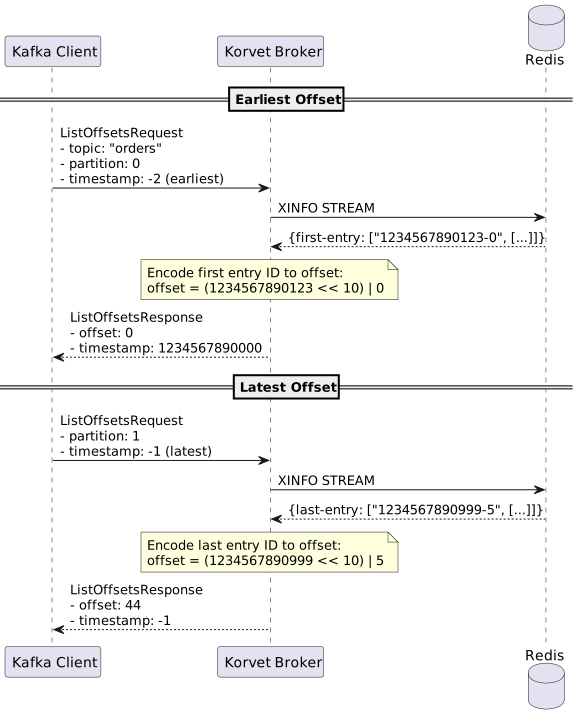
Redis Commands Detail
# 1. Get stream info to find first entry
XINFO STREAM korvet:storage:local:orders:0
# Returns stream metadata including:
# - first-entry: ["1234567890123-0", ["value", <value-bytes>, "timestamp", <ms>]]
# - last-entry: ["1234567890999-5", [...]]
# - length: 1000

# 2. Encode first entry ID to Kafka offset
# For "1234567890123-0" with sequenceBits=14:
#   offset = (1234567890123 << 14) | 0

# 3. Derive the timestamp from the entry ID (the millisecond component)
# timestamp = 1234567890123# Get stream info to find last entry
XINFO STREAM korvet:storage:local:orders:0
# Returns stream metadata including:
# - last-entry: ["1234567890999-5", [...]]
# Encode last entry ID to Kafka offset
# For "1234567890999-5" with sequenceBits=14:
# offset = (1234567890999 << 14) | 5
# Timestamp is -1 (convention for "latest")# 1. Convert timestamp to Redis Stream ID format (timestamp in ms)
# Kafka timestamp: 1234567890000
# Redis Stream ID: 1234567890000-0 (timestamp-sequence)
# 2. Find first entry at or after timestamp
XREAD COUNT 1 STREAMS korvet:storage:local:orders:2 1234567890000-0
# Returns: [["korvet:storage:local:orders:2", [["1234567890500-0", ["value", <value-bytes>, "timestamp", <ms>]]]]]
# 3. Encode entry ID to Kafka offset
# For "1234567890500-0" with sequenceBits=14:
# offset = (1234567890500 << 14) | 0
# 4. Derive the timestamp from the entry ID (the millisecond component)
# timestamp = 1234567890500
# Alternative: If no entry found at/after timestamp
XREAD COUNT 1 STREAMS korvet:storage:local:orders:2 1234567890000-0
# Returns: [] (empty) or [["korvet:storage:local:orders:2", []]]
# Response: offset = 0, timestamp = -1Implementation Notes
-
Earliest Offset (
timestamp = -2):-
Use
XINFO STREAMto get first-entry from stream metadata -
Encode entry ID to Kafka offset
-
Return the timestamp derived from the entry ID
-
If stream empty or doesn’t exist: return offset 0, timestamp -1
-
-
Latest Offset (
timestamp = -1):-
Use
XINFO STREAMto get last-entry from stream metadata -
Encode entry ID to Kafka offset
-
Timestamp is always -1 (convention for "latest")
-
-
Specific Timestamp:
-
Convert Kafka timestamp (ms) to Redis Stream ID format:
{timestamp}-0 -
Use
XREAD COUNT 1 STREAMS stream {timestamp}-0to find first entry at/after timestamp -
If no entry found: return offset 0 with timestamp -1
-
Derive the actual timestamp from the matched entry ID
-
-
Empty Partition:
-
XINFO STREAMreturns error if stream doesn’t exist -
Return: offset 0, timestamp -1
-
-
Performance:
XINFO STREAMis O(1) for finding earliest/latest offsets

