|
This version is still in development and is not considered stable yet. For the latest stable version, please use Korvet 0.20! |
Concepts & Architecture
Korvet is a Kafka-compatible streaming service backed by Redis Streams. This page explains the core concepts and the high-level architecture: how Kafka topics, offsets, and consumer groups map onto Redis primitives. If you only need to run or use Korvet, the Get Started and Using the Kafka API sections are enough. For the request-by-request implementation details, see Under the Hood.
Architecture
Korvet exposes a Kafka-compatible broker interface while persisting data in Redis-backed storage. At a high level:
-
Kafka protocol requests are terminated by the broker.
-
Kafka topics and partitions map onto Redis Streams.
-
Kafka offsets are translated to and from Redis Stream entry IDs.
-
Consumer-group behavior combines broker-side coordination with Redis-native delivery primitives.
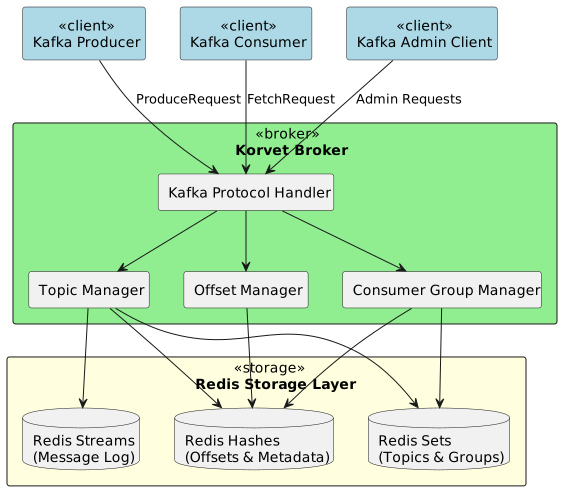
Kafka to Redis Model
| Kafka Concept | How Korvet Implements It |
|---|---|
Topic partition |
A Redis Stream |
Message record (key, value, headers, timestamp) |
A single Redis Stream entry |
Message offset |
Encoded from the Redis Stream entry ID — no offset table to maintain |
Consumer group |
A Redis Streams consumer group |
Committed offsets and topic metadata |
Tracked in Redis |
For the exact keys and structures, see Redis Data Structures.
Design Principles
-
Compatibility: Maintain full Kafka protocol compatibility so existing clients and tools work unchanged.
-
Statelessness: Offsets are computed from Redis entry IDs rather than stored in side tables (see Topics, Partitions, and Offsets).
-
Atomicity: Use Redis transactions (
MULTI/EXEC) and Lua scripts for atomic operations. -
Performance: Leverage pipelining, connection pooling, and caching for high throughput.
Topics, Partitions, and Offsets
Like Kafka, Korvet organizes messages into topics and partitions:
-
Topic: A logical stream of messages (e.g.,
orders,events). -
Partition: A topic is divided into partitions for parallelism; each partition maps to a Redis Stream.
-
Offset: Each message has a unique, monotonically increasing offset within its partition.
Offsets are stateless: rather than maintaining a side table, Korvet encodes the Kafka
offset directly from the Redis Stream entry ID ({timestamp}-{sequence}). This makes offset conversion an
O(1) computation in both directions and requires no extra storage. The number of bits reserved for the
sequence is tunable per topic (offset-sequence-bits) to trade write throughput against batch coherence;
see the configuration reference for defaults and limits, and
Offset Encoding for the exact formula.
Consumer Groups
Korvet implements Kafka consumer groups on top of Redis Streams native consumer groups:
-
Coordination: The broker implements the Kafka group coordinator protocol (join, sync, heartbeat, rebalance).
-
Delivery: Redis Streams consumer groups (
XREADGROUP) handle per-consumer delivery state. -
Offset management: Explicit Kafka commits are tracked in a separate committed-offset store, so consumer progress survives restarts.
-
Membership: Active group membership (members, assignments, generation) is held in broker memory. After a broker restart, groups with committed offsets remain visible to admin APIs in the
Emptystate until their clients rejoin.
Message Format
Messages follow the Kafka record format:
-
Key: Optional message key (byte array).
-
Value: Message payload (byte array).
-
Headers: Optional key-value metadata.
-
Timestamp: Message timestamp.
Each Kafka record is stored as a single Redis Stream entry whose body breaks the record out into separate,
directly-readable value, key, headers, and timestamp fields, so a non-Kafka client can read the
payload straight from the stream (for example with XRANGE). A field is omitted when its component is
absent. See Redis Data Structures for the exact
layout.
Next Steps
-
Using the Kafka API — produce, consume, and manage topics
-
Tiered Storage — local and remote tiers, and how data moves between them
-
Under the Hood — request workflows, protocol mapping, and internals

