|
This version is still in development and is not considered stable yet. For the latest stable version, please use Korvet 0.20! |
Consumer Workflow (Standalone)
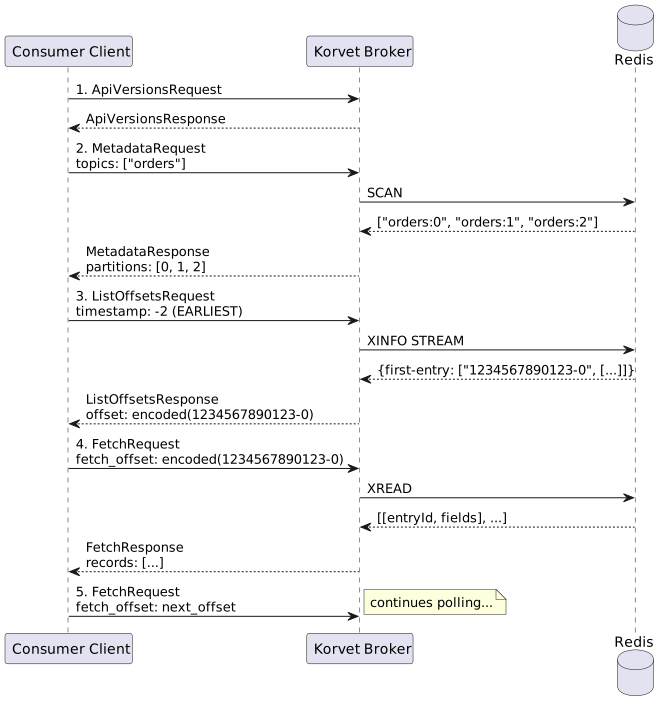
This page describes the complete Kafka API interaction sequence for a standalone consumer (not part of a consumer group).
| This workflow is intended for readers who need to understand broker behavior end to end. For task-oriented user guidance, prefer Consuming Messages. |
Overview
A typical standalone consumer workflow involves the following API calls:
-
ApiVersions - Negotiate protocol version with broker
-
Metadata - Discover topics and partitions
-
ListOffsets - Find the beginning or end offset of partitions
-
Fetch - Read messages from topic partitions
API Sequence
1. ApiVersions Request
The client first negotiates the protocol version (same as producer).
ApiVersionsRequest {
  client_software_name: "apache-kafka-java"
  client_software_version: "3.9.1"
}
See Producer Workflow for response details.
2. Metadata Request
The client discovers available topics and their partitions (same as producer).
MetadataRequest {
  topics: ["orders"]
  allow_auto_topic_creation: false
}
See Producer Workflow for response details.
3. ListOffsets Request
The client finds the starting offset for consumption (earliest, latest, or specific timestamp).
ListOffsetsRequest {
  replica_id: -1  // consumer
  isolation_level: 0  // READ_UNCOMMITTED
  topics: [
    {
      name: "orders"
      partitions: [
        {
          partition_index: 0
          timestamp: -2  // EARLIEST
          max_num_offsets: 1
        }
      ]
    }
  ]
}
ListOffsetsResponse {
throttle_time_ms: 0
topics: [
{
name: "orders"
partitions: [
{
partition_index: 0
error_code: 0
timestamp: 1234567890000
offset: 0
}
]
}
]
}Redis Commands
# For EARLIEST (-2): Get first entry
XINFO STREAM korvet:storage:local:orders:0
# Returns stream metadata including first-entry: ["1234567890123-0", {...}]

# Encode entry ID to Kafka offset (stateless)
# For "1234567890123-0" with sequenceBits=10:
#   offset = (1234567890123 << 10) | 0

# For LATEST (-1): Get last entry
XINFO STREAM korvet:storage:local:orders:0
# Returns stream metadata including last-entry
# Encode to offset using same formula
4. Fetch Request
The client reads messages from the partition starting at the desired offset.
FetchRequest {
  max_wait_ms: 500
  min_bytes: 1
  max_bytes: 52428800  // 50 MB
  isolation_level: 0  // READ_UNCOMMITTED
  topics: [
    {
      topic: "orders"
      partitions: [
        {
          partition: 0
          fetch_offset: 0
          partition_max_bytes: 1048576  // 1 MB
        }
      ]
    }
  ]
}
FetchResponse {
throttle_time_ms: 0
topics: [
{
topic: "orders"
partitions: [
{
partition_index: 0
error_code: 0
high_watermark: 42
last_stable_offset: 42
records: [
{
offset: 0
timestamp: 1234567890000
key: "order-123"
value: {"product": "widget", "quantity": 5}
headers: [...]
},
{
offset: 1
timestamp: 1234567891000
key: "order-124"
value: {"product": "gadget", "quantity": 3}
headers: []
}
]
}
]
}
]
}Redis Commands
# Decode Kafka offset to Redis Stream entry ID (stateless)
# For offset 0 with sequenceBits=10:
#   timestamp = 0 >> 10 = 0
#   sequence = 0 & 1023 = 0
#   entry_id = "0-0"

# Fetch messages from stream
XREAD COUNT 100 STREAMS korvet:storage:local:orders:0 0-0
# Returns: [
#   ["korvet:storage:local:orders:0", [
#     ["1234567890123-0", ["key", "order-123", "value", "...", ...]],
#     ["1234567890123-1", ["key", "order-124", "value", "...", ...]]
#   ]]
# ]
Key Differences from Group Consumer
-
No group coordination: No JoinGroup, SyncGroup, Heartbeat, or LeaveGroup calls
-
No offset commits: Consumer tracks offsets locally (or in external storage)
-
Manual partition assignment: Consumer explicitly chooses which partitions to read
-
No rebalancing: Adding/removing consumers doesn’t trigger partition reassignment

